Can a Team of AI Agents Write Better Software Than One?
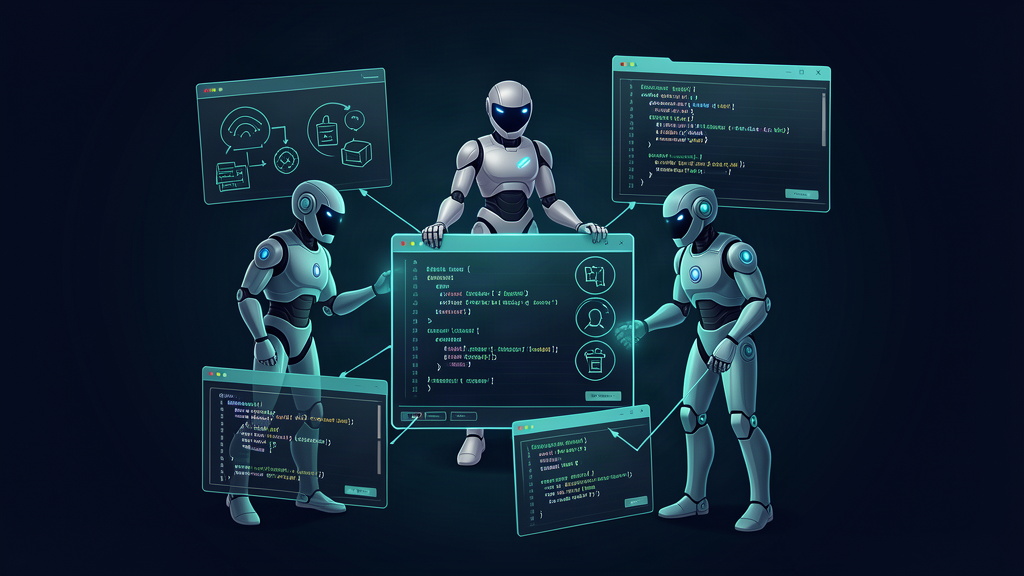
One AI assistant can read a feature request, write code, and suggest tests. A team of AI agents divides those jobs among separate agents. One may turn the request into requirements, another may write the code, and a third may review and test it.
The idea is appealing because software development involves different kinds of work. But a team is not automatically better than one agent. The result depends on how the work is divided, what information each agent receives, and whether the final software actually satisfies the request.
What is an AI agent team?
An AI agent is a software component that uses an AI model to perform a task, often with instructions and access to tools. An agent team coordinates several such components. Each agent can have a different role, such as planner, programmer, or tester.
Different roles do not necessarily mean different models. A team can use the same model for every agent, or it can assign different models to different tasks. The second approach is often called a heterogeneous team. It may use a model selected for planning, another for coding, and another for review. Those choices should be based on evidence for the tasks, not just the models’ names.
A concrete example: a task-tracking application
Suppose you want to build a small task-tracking application. Users should be able to create a task, mark it complete, and see only their own tasks. A three-agent workflow could look like this:
- Requirements agent: Turns the request into a list of features and acceptance criteria, including the rule that users cannot see one another’s tasks.
- Implementation agent: Uses those criteria to build the application and record its assumptions.
- Testing agent: Checks the application against the original request, including a test that tries to access another user’s tasks.
The testing agent should receive the original request, not only the implementation agent’s description of its work. Otherwise, an omitted requirement can disappear before testing begins. A final integration step must also check that the pieces work together.
A prompt to start with
You can adapt this prompt for a multi-agent system, or use it to structure separate conversations with your chosen tools:
Build a small task-tracking application.

Requirements:
- A user can create a task and mark it complete.
- A user can see only their own tasks.

Planner: List the requirements and acceptance criteria.
Developer: Implement the application using those criteria.
Tester: Use the original requirements to design functional
and access-control tests. Report any failures.

Return the final code, test results, and any known limitations.
Do not claim a test passed unless it was actually run.
This prompt describes roles; it does not create separate agents or give them access to tools by itself. The platform must provide those capabilities. Review the output and run tests in a suitable environment before using the application.
Why use different agents?
Separate roles make responsibilities explicit. A testing agent can focus on behavior the implementation agent may have missed. A requirements agent can identify missing details before coding begins. If the platform supports parallel work, some independent tasks may also run at the same time.
Different models may bring different strengths or costs. A team might use a less expensive model for a routine task and reserve another model for a difficult review. That is a design choice to test, not a guarantee: a model that performs well on one benchmark may not perform best on your project.
Research systems such as MetaGPT and ChatDev explore role-based collaboration for software development. They show ways to organize agents; they do not establish that every team, or every combination of models, will outperform a single agent on every task.
Where collaboration can fail
Errors can travel between agents. If the requirements agent omits the privacy rule, the developer may never implement it. If the tester sees only the developer’s summary, the omission may go unnoticed.
Agents can disagree or misunderstand one another. One agent may describe a task identifier as a number while another expects text. Both outputs can look reasonable on their own, yet fail when combined.
Review is not independent by default. Different roles, and even different models, can share the same incorrect assumption. A reviewer that agrees with the developer is not proof the code is correct.
More agents add cost. Each handoff can add model calls, time, and context to manage. Parallel execution may reduce waiting time for independent work, but extra coordination can also make a team slower or more expensive.
Access needs limits. Agents that can read files, execute commands, or call external services should receive only the permissions they need. Untrusted content can also contain instructions that attempt to redirect an agent. Isolated execution and careful review reduce risk, but they do not eliminate it.
How to compare a team with one agent
Use the same development tasks and requirements for both approaches. Give the single agent a fair chance to plan, implement, and review its work; a weak baseline makes the comparison misleading. Keep tools and resources comparable, and record any differences in time or budget.
Then evaluate the final software with the same independent checks. Measure whether it implements the requested features, whether its parts work together, and whether it passes functional and security tests. Record failures as well as successes, and compare the time and cost of producing each result.
If the team performs better on one task, that is a useful observation, not proof that the same setup will work best everywhere. Repeat the comparison across tasks and runs before drawing broader conclusions.
AI agent teams offer a way to divide development work and bring different reviews into the process. Whether that improves the final software is an empirical question. The most useful answer comes from testing the finished application against the original requirements, then weighing any improvement against the extra coordination and cost.